

Chasing Flow Issue 03: Decided Somewhere You Weren’t
Chasing Flow · Issue 03 · 29 September 2026
Where the choice actually gets made, and what you can check from here.
Chasing Flow is written for engineered-product and industrial technology companies that treat go-to-market the way they treat the plant floor — as something you improve continuously, never something you finish.
Hence the name — Chasing Flow. Flow is real and it's achievable, and it doesn't hold still: competitors move, the market shifts, your own product mix changes, and the alignment that produced flow last year quietly stops producing it. So the pursuit is the permanent condition, not a project with an end date. Every other week this newsletter gives you ways to evaluate where your GTM is actually breaking and what to do about it — practical diagnostics, the numbers behind them, and a path back toward flow.
In this issue
- Headwaters — the idea running through the issue
- A materials company can have the better technology and still have no way to reach the buyer.
- Two companies. Same revenue, same product, same shortfall. One of them should add two reps. The other shouldn't.
- How long until a new salesperson is productive? Don't take a benchmark. Calculate it from your own numbers.
- A flat quarter looks the same no matter what caused it.
- Sixty-two percent of the technical buying journey happens online before anyone contacts a vendor.
- Seventy percent of engineers are likely to choose the better-known brand.
- Tributary — eighteen months of outbound taught her less than five deals did
- Downstream — one thing to do before the next issue
Headwaters

Headwaters — the streams at the source of a river, where it begins. Just as the headwaters set the course a river takes, this section states the one idea running through the issue.
Six diagnostics this issue, and the same thing sits underneath all of them. The decision that determines your revenue gets made in a room you're not in, on a clock you didn't set, using information you didn't supply.
An actuator builder decides whether your material goes into the munition, and the prime never sees your name. An engineer picks between you and an incumbent in a meeting where the only things on the table are two datasheets claiming the same three capabilities. A buyer forms a view of you reading a publication you don't control, then calls with the conclusion already reached. Your median sales cycle decides when a new hire starts producing, and that clock belongs to the customer.
The second half is the uncomfortable part. In every one of those, the evidence exists. Your last ten buyers can tell you what they read before they called. Quote dates and close dates are already in a system. The median cycle is calculable this afternoon. The accounts you should be quoting and aren't can be listed by name.
Nobody pulls any of it, because the theory you already believe arrives free and an afternoon of records doesn't. So the free one wins, gets repeated in the next meeting, and settles in. Which of the things your leadership team is sure about has ever been checked against a record?
The Current

The current — the body of water in steady motion, and what's moving through it now. Just as the current carries the volume of a river, this section carries the substance of the issue — the working ideas, in full.
Getting Specified · Target Customers
A materials company can have the better technology and still have no way to reach the buyer.
Niron Magnetics makes permanent magnets from iron nitride, with no rare earths in them. The end users who'd benefit are defense primes and platform integrators. But a prime doesn't choose your magnet. They specify an actuator, and whoever builds the actuator decides what goes inside it.
Niron and Moog are collaborating on rare-earth-free actuator designs for guided munitions. Moog is evaluating iron nitride for motion control. Moog has decades of qualified position in defense actuation.
As a commercial move, that's a company routing its technology through a supplier whose parts are already accepted.
Performance gets you evaluated. Qualification gets you in, and qualification is where new materials stall. Going it alone means funding years of validation before revenue, while explaining an unfamiliar technology to a buyer with no reason to carry the risk.
Entering through an incumbent skips the introduction. Their qualification history does the work yours hasn't earned yet.
What you're buying is their qualified position. The patent matters less than what it would cost the customer to requalify around you.
Then there's the other direction, which shows the price.
In August CesiumAstro acquired Jariet Technologies. Jariet sold RF chips to the merchant market as catalog parts, chiplets and IP, to anyone who wanted them. CesiumAstro builds complete satellites. Jariet's roadmap now answers to a system integrator.
If you were one of Jariet's other customers, what are you asking yourself this month?
That's the same trade seen from the far end. You're a component inside someone else's product. The customer relationship isn't yours, the pricing conversation isn't yours, and the roadmap eventually isn't either.
So the question isn't who benefits from what you make. It's who decides whether it gets used.
Those are often different companies, and only one of them is your actual market.
Founder-Led Sales
Two companies. Same revenue, same product, same shortfall. One of them should add two reps. The other shouldn't.
The obvious checks won't separate them. Both products are good. Both teams work hard. The difference isn't effort and it isn't money.
What separates them is whether there's a pattern underneath for a new rep to repeat. If there is, a hire compounds. If there isn't, you've bought yourself a second person building their own private version of the job, and you'll do this again with the next one.
That's checkable before you commit, which matters because a hire takes months to unwind and a distributor agreement has a term on it.
Seven questions. You'll know before you make the hire: systematize.mhflow.co
Revenue Metrics
How long until a new salesperson is productive? Don't take a benchmark. Calculate it from your own numbers.
One full sales cycle, plus a quarter. What that means for the cost of the hire, the first-year quota, and which part of the ramp you can actually compress.
Founder-Led Sales · Target Customers · Revenue Metrics
A flat quarter looks the same no matter what caused it.
At least four commercial causes produce the identical quarter, each with a different fix, and all four are checkable from records you already have.
Getting Specified
Sixty-two percent of the technical buying journey happens online before anyone contacts a vendor. Sixty-nine percent of technical buyers now use generative AI somewhere in that process.
Both from the 2026 State of Marketing to Engineers research by GlobalSpec and TREW Marketing, ninth year, over a thousand engineers surveyed.
Put those two numbers together and the usual conclusion is that you'd better show up in the AI answers or disappear.
The same research complicates that. Engineers rate their trust in generative AI answers at 4.7 out of 10. Seventy-five percent have noticed AI summaries at the top of search results, and of those, 69 percent read the summary and then keep going through the results anyway. Six percent say the summary is usually enough.
The researchers' own reading is that buyers use AI as a shortcut for discovery, then verify somewhere else.
Which splits your content into two jobs.
Discovery is being found. Search, AI answers, directories, product pages. You can measure it, and most companies fund it.
Verification is being believed, with nobody from your company in the room. That is where the decision gets made.
And verification has moved. For the first time in nine years of this study, online technical publications edged out vendor websites as where technical buyers routinely research, 76 percent to 74. Buyers are gravitating to sources that read as editorially independent, which means opinions form about you in places you don't control.
Being legible to an AI is table stakes for discovery. It does almost nothing for verification.
So here's the test. Take your last ten wins. Ask each buyer where they first heard your name, then ask what they read before they called you.
The second answer is your verification set. If they struggle to name anything, or name something a competitor published, that's the gap.
Discovery gets you considered. Verification gets you chosen. Most industrial companies fund the first and hope for the second.
Getting Specified
Seventy percent of engineers are likely to choose the better-known brand.
The figure gets quoted without the condition attached: two technically similar solutions. What that means for a challenger, and the two problems it has to solve.
Tributary

Tributary — a stream that rises elsewhere and joins the main channel. Just as a tributary adds to a river, this section covers outside go-to-market research and what changes when the product is physical.
Eighteen months of outbound taught her less than five deals did
Writing in Run on GTM OS on 15 September, Sangram Vajre separates a GTM motion from a GTM strategy. The motion is the channel, outbound or inbound or partner or event. The strategy is knowing who you're selling to, what problem they can't ignore, and how they actually buy. A founder in his account spent eighteen months building outbound before five high-touch deals gave her what she needed. His argument is that you can only scale after doing unscalable things first, and for companies between $5M and $15M his advice is to take the best twenty customers and trace how each one was really acquired.
Three things change when the product is physical.
The unscalable work isn't the founder's time. It's application engineering hours, and those are the same hours the installed base is already calling for. Ten deals worked properly means ten applications an engineer isn't spending on a warranty question or a replacement sizing. That trade is a scheduling decision somebody has to make on purpose, because left alone it resolves toward whoever is shouting, and that's always the existing customer.
Tracing how twenty customers were acquired is also harder than it sounds, because for most of them you weren't there. The order came through a rep or a distributor. What you hold is a PO and a ship date. Who raised it, what you were compared against, who else got quoted, all of that sits with someone paid on orders rather than on telling you.
And how those buyers buy has more than one answer inside one company. A part qualified onto a platform, a product specified into a one-time project, a catalog item swapped at the moment of quoting, and a capital purchase with no drawing behind it at all are four different processes with four different switching costs. A company with three product lines can be running three of them. If you trace one acquisition path and generalize it, you've learned about one product line and filed it as a strategy.
Source: She Spent 18 Months on Outbound. Five Unscalable Deals Fixed What It Couldn't., Sangram Vajre, Run on GTM OS, 15 September 2026. GTM OS and the eight pillars are their framework.
Downstream

Downstream — the direction the water is already traveling. Just as a river carries everything downstream, this section points at the one thing worth doing before the next issue lands.
Take the last ten wins and ask each buyer two questions. Where did you first hear our name, and what did you read before you called us. That's a week of calls at most, and it settles two of the arguments in this issue without anyone having to win the meeting.
Why run on an operating system
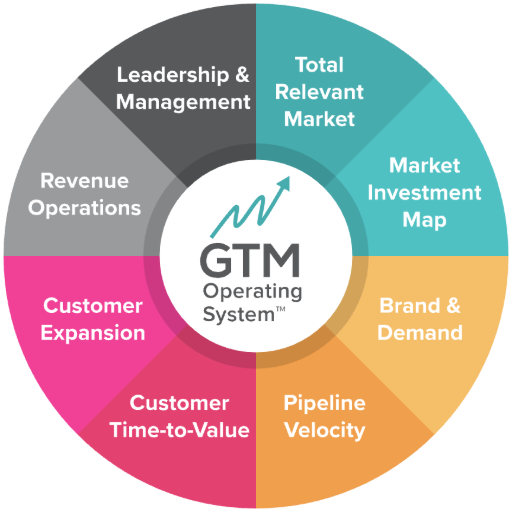
Eight pillars, one system, and each one builds on the next. More than 2,000 GTM teams have been assessed against it, and the assessment is the useful part: it tells you which pillar is actually holding you back, rather than the one making the most noise. Fix that pillar and the effect carries into the ones that follow. What your leadership team ends up with is one vocabulary and one set of numbers everyone has signed up for, which is what turns activity into growth you can plan around.
Curious what it would surface in your business? Take the assessment — it's the fastest way to see which pillar is holding you back.
Get the next issue on LinkedIn. Chasing Flow publishes every other Tuesday. Subscribe on LinkedIn.
Working through one of these in your own business? See how Flow works with companies.
Chasing Flow is written by Michele Hodde. GTM OS and the eight-pillar operating system are trademarks of GTM Partners, licensed to Michele Hodde as a certified practitioner.